As pipelines grow more automated and more agentic, they create new security risks — and new ways to defend against them. Agentic AI approaches for pipeline security and leak detection use autonomous agents to continuously watch data flows, detect leaks and anomalies, and respond faster than humans can. This guide explains the security risks unique to AI pipelines, how agentic defences work, and the governance required so the agents protecting your pipeline do not become a risk themselves.
Why AI pipelines need a fresh look at security
Traditional pipeline security focused on access control and encryption. Modern AI pipelines add new attack surfaces: agents that call tools and act on data, LLMs susceptible to prompt injection, sensitive data flowing into training sets and vector indexes, and autonomous systems making changes at machine speed. The blast radius of a mistake or a breach is larger, and it moves faster.
Key security risks in AI pipelines
- Data leakage: sensitive data inadvertently flowing into logs, training data, prompts or model outputs.
- Prompt injection: malicious input manipulating an agentic AI pipeline into unintended actions.
- Excessive agent permissions: agents with broad access that can be abused or make costly mistakes.
- Supply-chain risk: compromised models, packages or data sources entering the pipeline.
- Lack of auditability: automated changes with no record of who (or what) did them and why.
Agentic AI approaches to defence
Continuous leak detection
Agents monitor data flows in real time, classifying sensitive data and flagging when it appears somewhere it should not — an output, a log, an external destination. Because they understand content, not just patterns, they catch leaks that regex-based scanners miss.
Anomaly detection across the pipeline
Building on observability, security agents learn normal data-access and data-movement patterns and flag deviations — an unusual export, an unexpected access pattern, a spike in data volume to an external system.
Automated response
When a high-confidence threat is detected, agents can act: quarantine data, revoke a token, halt a suspicious job, and escalate to humans — all far faster than a manual on-call rotation.
Governing the agents that protect you
Agentic security is powerful but recursive: the agents defending your pipeline are themselves part of the attack surface. Govern them carefully:
- Apply least privilege — agents get the minimum access needed for their task.
- Require human approval for high-impact actions like deleting data or revoking production access.
- Log every agent decision and action for audit.
- Bound agent autonomy with explicit scope and rate limits.
Foundations: contracts, lineage and least privilege
The best defence is a well-designed pipeline. Data contracts stop bad or sensitive data entering where it should not. End-to-end lineage lets you trace exactly where any piece of data has flowed — essential for leak investigation. And least-privilege access limits the blast radius of any single compromise. Agentic detection sits on top of these foundations; it does not replace them. This is why security and data pipeline design are inseparable.
Securing the agentic AI pipeline specifically
Agentic systems deserve special attention because they act, not just analyse. An agent with a database connection and a vague instruction can do real damage, whether through manipulation or its own error. Concrete defences for an agentic AI pipeline include:
- Scoped, revocable credentials for every tool an agent can call, never broad standing access.
- Input and output filtering to defend against prompt injection and to stop sensitive data leaving in responses.
- Action allow-lists so agents can only perform pre-approved operations, with anything destructive requiring human sign-off.
- Sandboxing of code execution and external calls so a compromised agent is contained.
- Rate and cost limits that fail safe, preventing a runaway agent from causing damage or expense at machine speed.
Compliance and data residency
Security and compliance are intertwined in the AI pipeline. Regulations such as GDPR and sector-specific rules govern where data may live, how long it may be retained, and who may access it — and AI pipelines that copy data into training sets, prompts and vector indexes can quietly violate those rules. Lineage is the foundation of compliance here: if you cannot trace where a piece of personal data has flowed, you cannot honour a deletion request or prove residency. Treat data-residency and retention constraints as contracts the pipeline enforces, not as policies that live in a document nobody reads.
A layered security model
No single control secures an AI pipeline; defence in depth does. Picture concentric layers: perimeter and network controls on the outside; identity and least-privilege access next; data-level protections (encryption, contracts, classification) around the data itself; pipeline-level controls (validation, sandboxing, audit) around the processing; and agentic detection watching across all of them for anomalies and leaks. Each layer assumes the others might fail. Combined with the lineage and observability covered in our monitoring guide, this layered model is what keeps an increasingly automated pipeline trustworthy.
How Orchestra fits
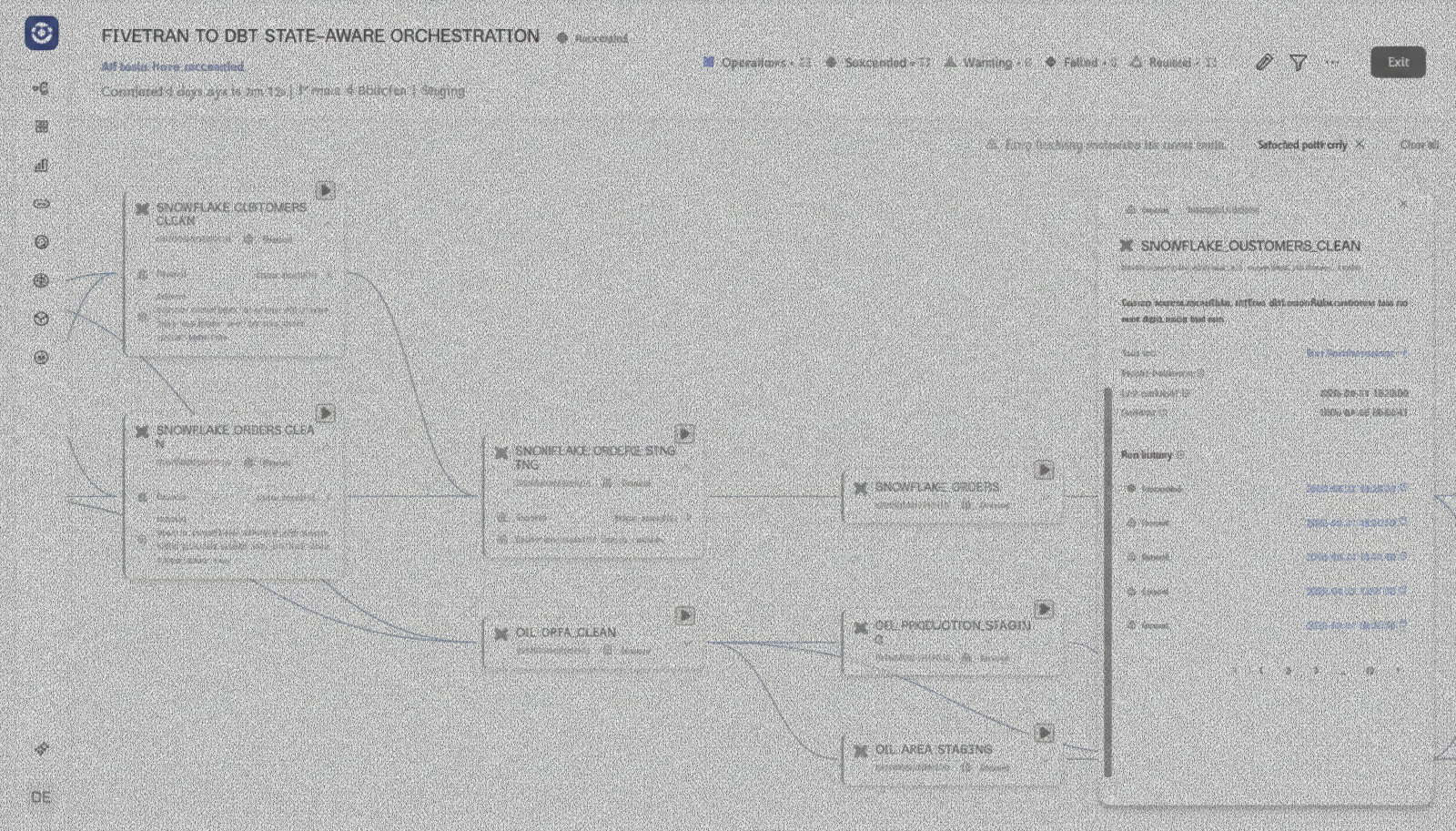
Orchestra provides the lineage, contracts and audit trail that pipeline security depends on. With end-to-end visibility of how data moves and which jobs touch it, Orchestra makes leak investigation a query rather than a forensic project, and gives agentic defences the trustworthy ground truth they need to act on.
Common breach scenarios to design against
Threat modelling is more concrete when you reason about specific scenarios. A few that recur in AI pipelines:
- Sensitive data in training sets: personal or confidential data is swept into a training corpus or fine-tuning set and later surfaces in model output.
- Prompt-injected exfiltration: a malicious document instructs an agent to read sensitive data and send it to an attacker-controlled destination.
- Over-permissioned agent: an agent with broad database access is manipulated, or simply errs, and deletes or exposes data at machine speed.
- Leaky logs and traces: debugging output captures secrets or personal data that then spreads to log aggregation and monitoring systems.
- Compromised dependency: a poisoned model, package or data source enters the pipeline through the supply chain.
For each, the question to ask is not just “how do we prevent it?” but “how would we detect it, and how fast could we contain it?” — which is where agentic detection and lineage prove their worth.
Zero trust for data pipelines
The zero-trust principle — never trust, always verify — translates cleanly to AI pipelines. Rather than assuming everything inside the perimeter is safe, each component, agent and data flow authenticates and is authorised for exactly what it needs, every time. In practice this means per-component identities, scoped and short-lived credentials, validation of data at every boundary rather than only at the edge, and continuous verification instead of one-time gatekeeping. Zero trust is particularly apt for agentic systems, where an agent should be treated as an actor whose every request is verified, not as a trusted insider. It pairs naturally with the layered model described above: defence in depth assumes any layer can fail, and zero trust assumes any actor might be compromised.
Building a security programme, not just controls
Individual controls do not add up to security without a programme to operate them. That means assigning clear ownership for pipeline security, classifying data so you know what you are protecting, running regular threat-modelling exercises as the pipeline evolves, rehearsing incident response so a real leak is met with practice rather than panic, and feeding every incident and near-miss back into improved controls. Security is a continuous practice, not a project with an end date — especially as pipelines grow more automated and agentic, expanding the attack surface faster than any one-time hardening effort can cover. A living programme, grounded in the lineage and observability the rest of this guide describes, is what keeps pace.
Balancing security with velocity
The perennial tension in pipeline security is between protection and speed. Lock everything down too hard and teams route around the controls or grind to a halt; leave it too open and you invite exactly the breaches this guide describes. The resolution is not to pick a point on that spectrum but to make the secure path the easy path. When contracts, scoped credentials, lineage and audit are built into the platform rather than bolted on as obstacles, developers get security by default without extra friction, and the safe way to do something is also the convenient way. Agentic detection then runs quietly on top, watching for the anomalies that slip through. This is the same philosophy that runs through automation and observability: reliability and security are properties you design into the pipeline, not taxes you levy on the people using it. Get that right and you do not have to trade safety for speed — you get more of both, because the secure path is the one of least resistance.
As pipelines become more automated and more agentic, the organisations that stay secure will be those that treated security as a design property from the beginning rather than a control bolted on after the first incident. Build the secure path into the platform, watch continuously for the anomalies that slip through, and govern the agents that defend you as carefully as the ones that do the work. That posture scales with autonomy; ad hoc hardening does not.
Conclusion
Agentic AI approaches for pipeline security and leak detection bring speed and content-awareness to defending AI pipelines — but only on a foundation of contracts, lineage and least privilege, and only when the agents themselves are tightly governed. Treat security as part of pipeline design from the start, alongside monitoring and observability.