ETL — extract, transform, load — has been the backbone of data integration for decades. The arrival of capable AI agents is changing how ETL is built and run, giving rise to the AI ETL pipeline: a data integration pipeline where AI handles the brittle, manual parts that used to consume most of an engineer’s time. This article explains how the AI ETL pipeline works, where AI agents for ETL data pipelines genuinely help in 2026, and the guardrails you need to keep them trustworthy.
What is an AI ETL pipeline?
An AI ETL pipeline is an extract-transform-load workflow augmented or partly operated by AI. Instead of an engineer hand-writing every connector, mapping and transformation, AI models infer schemas, generate transformation logic, map fields between systems, and adapt when sources change. The classic ETL stages remain — the intelligence applied to each stage is what is new.
It sits squarely inside the broader AI data pipeline, focused specifically on the integration problem: getting data out of many heterogeneous systems and into a consistent, usable shape.
The stages of an AI ETL pipeline
AI-assisted extraction
Extraction is traditionally where integrations break: APIs change, schemas drift, and documents arrive in inconsistent formats. AI excels at extracting structure from semi-structured and unstructured sources — parsing PDFs, normalising inconsistent JSON, and inferring the schema of an unfamiliar source. This dramatically reduces the time to onboard a new data source.
AI-driven transformation
Here AI generates and maintains transformation logic from natural-language intent, suggests joins and field mappings, and flags anomalies that rules would miss. The engineer moves from writing every line of SQL to reviewing and approving AI-proposed transformations — faster, but only safe with strong testing.
Loading with validation
Transformed data is loaded into the destination warehouse or lakehouse, ideally behind a write-audit- publish pattern: write to a staging area, validate against contracts, and only publish if the checks pass. This is where the AI ETL pipeline earns trust, because AI-generated logic must never be allowed to load bad data unchecked.
AI agents for ETL data pipelines in 2026
The leading edge of the AI ETL pipeline is agentic: rather than a single model performing one task, an agentic AI pipeline coordinates several specialised agents. One agent profiles a new source, another proposes a mapping, another writes tests, and an orchestrator decides what to do when reality diverges from expectation. In 2026 the most useful agents for ETL data pipelines tend to focus on bounded, verifiable tasks — schema inference, mapping suggestion, anomaly triage — rather than running the whole pipeline unsupervised.
Benefits of the AI ETL pipeline
- Faster onboarding of new data sources, because schema inference and mapping are automated.
- Resilience to change. When a source schema drifts, AI can adapt mappings instead of breaking the pipeline.
- Lower maintenance. A large share of data engineering time goes to maintaining brittle integrations; AI absorbs much of that toil.
- Unstructured data support brings documents, text and images into the warehouse alongside structured data.
Risks and guardrails
The danger of an AI ETL pipeline is the same as its promise: AI will confidently produce transformations that look right and are subtly wrong. The guardrails that make it safe are familiar from good data engineering:
- Enforce data contracts and fail closed when AI-generated logic violates them.
- Keep a human in the loop to approve mappings and transformations for critical data.
- Use write-audit-publish so nothing reaches consumers without passing validation.
- Maintain full lineage so you can trace any value back through the AI-generated steps that produced it.
Choosing tools for your AI ETL pipeline
The market is crowded, from incumbents adding AI features to AI-native integration startups. Evaluate them on how well they handle schema drift, how transparent their AI-generated logic is, and how they integrate with your orchestration and governance layers. Our guide to AI pipeline automation tools covers how to compare the broader category.
AI ETL vs. ELT vs. reverse ETL
The integration landscape has more than one pattern, and AI is reshaping all of them. Classic ETL transforms data before loading it into the destination. ELT loads raw data first and transforms it inside the warehouse, which has become the modern default thanks to cheap, scalable compute. Reverse ETL pushes modelled data back out from the warehouse into operational tools like CRMs. AI helps across all three: inferring schemas and mappings on the way in, generating transformations in the warehouse, and intelligently syncing data back out. The AI ETL pipeline is best understood as AI applied to whichever integration pattern fits your stack, not a replacement for the patterns themselves.
Handling schema drift with AI
Schema drift — when a source changes its structure without warning — is the silent killer of traditional integrations. A column is renamed, a field changes type, a nested object gains a level, and the pipeline either breaks loudly or, worse, succeeds while corrupting data. This is where the AI ETL pipeline genuinely shines. AI can detect that a source has changed, reason about how the new structure maps to the old one, and propose an updated mapping for a human to approve — turning what used to be an outage into a notification. The key is that the adaptation is suggested and validated, never applied blindly to production data.
A practical adoption path
You do not have to rebuild your integration layer to benefit from AI ETL. A low-risk path:
- Start with onboarding. Use AI to accelerate connecting and mapping new sources, where the time savings are largest and the risk is contained.
- Add drift detection to existing pipelines so you are warned about source changes before they cause incidents.
- Introduce AI-assisted transformation for non-critical data first, building confidence and a test suite before applying it to core tables.
- Keep write-audit-publish everywhere, so AI-generated logic is always validated before it reaches consumers.
This incremental approach captures most of the value of the AI ETL pipeline while keeping the blast radius of any mistake small.
How Orchestra fits
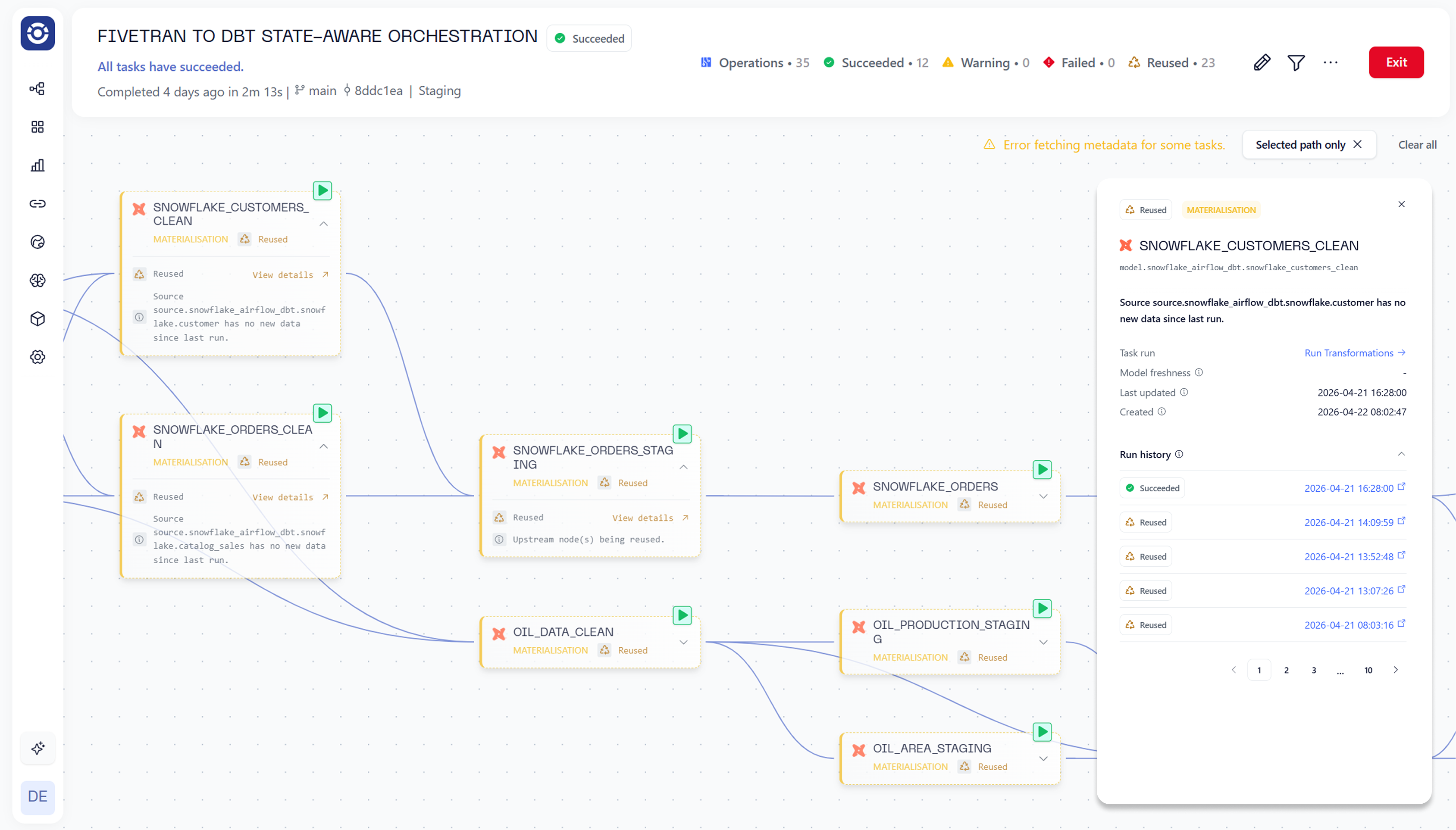
Orchestra orchestrates AI ETL pipelines alongside the rest of your stack, applying contracts, lineage and write-audit-publish so that AI-accelerated integration stays reliable. You get the speed of AI-driven ETL without surrendering the governance that production data demands.
Keeping a human in the loop
The most successful AI ETL pipelines are not fully autonomous; they are collaborative. AI does the heavy lifting — profiling sources, drafting mappings, generating transformation logic — and a human provides judgement at the points where being wrong is expensive. The skill of the data engineer shifts from writing every line to defining intent, reviewing AI proposals, and curating the test suite that keeps the AI honest. This human-in-the-loop model is not a transitional phase to be engineered away; for production data it is the design. The goal is to remove toil, not accountability, and a clear division of labour — AI for volume and speed, humans for judgement and approval — is what makes AI-driven integration both fast and safe.
Measuring AI ETL pipeline success
How do you know your AI ETL pipeline is actually delivering? Track a small set of outcome metrics rather than vanity numbers:
- Time to onboard a new source, which AI should dramatically reduce.
- Maintenance hours per pipeline, a measure of how much toil AI is genuinely absorbing.
- Incidents from schema drift, which good drift detection should drive toward zero.
- Data quality at the destination, ensuring speed has not come at the cost of correctness.
- Contract violations caught before they reached consumers, evidence the guardrails are working.
If AI accelerates onboarding but quietly degrades destination data quality, that is a bad trade — and only outcome metrics will reveal it. The point of the AI ETL pipeline is faster integration without sacrificing the trust that makes data useful.
The future of the AI ETL pipeline
Where is the AI ETL pipeline heading? The clear trajectory is toward integration that is increasingly self-managing: connectors that adapt to source changes without human intervention, transformations that maintain themselves as schemas and business logic evolve, and pipelines that detect and repair their own breakages. The destination resembles the self-healing systems discussed across this site — integration that absorbs change rather than breaking on it. Two forces will shape how fast we get there. The first is the maturation of agentic systems capable of bounded, verifiable autonomy over integration tasks. The second is the standardisation of interfaces between tools and data, which makes it far easier for AI to reason about and connect heterogeneous systems. What will not change is the need for guardrails: as integration becomes more autonomous, contracts, validation and lineage become more important, not less, because there are fewer humans in the loop to catch a confident mistake. The teams that prepare now — by building strong data foundations and governance — will adopt each advance safely, while those without them will find autonomy amplifies their existing fragility.
Conclusion
The AI ETL pipeline takes the most painful part of data integration — brittle, ever-changing extraction and transformation — and lets AI absorb much of the toil, while disciplined guardrails keep the output trustworthy. Pair it with a solid AI data pipeline and an agentic approach to get the most from it.