Continuous integration and continuous delivery transformed software engineering, and now AI is transforming CI/CD itself. The AI CI/CD pipeline uses AI to make builds, tests and deployments faster, smarter and more reliable — and, for AI products, to ship models and prompts with the same rigour as code. This guide covers what an AI CI/CD pipeline is, where agentic AI in the CI/CD pipeline helps, and the best AI tools for optimizing CI/CD pipelines in 2025 and 2026, including for containerized AI development.
What is an AI CI/CD pipeline?
An AI CI/CD pipeline is a continuous integration and delivery workflow enhanced by AI in two senses. First, AI optimises the pipeline itself: predicting which tests to run, triaging failures, reviewing code, and flagging risky changes. Second, the pipeline is adapted to ship AI artefacts — models, prompts, datasets and indexes — with versioning, evaluation gates and safe rollout. The two come together when you are building AI products: you need CI/CD that is both powered by AI and capable of deploying AI.
How AI optimises the CI/CD pipeline
Smarter testing
AI predicts which tests are most likely to catch a regression for a given change, runs them first, and can skip irrelevant suites — cutting feedback time from hours to minutes. It can also generate tests for uncovered code paths.
Failure triage and root-cause analysis
When a build breaks, AI summarises the failure, correlates it with recent changes, and suggests a fix. This is one of the highest-value uses of AI in the CI/CD pipeline because it attacks the most expensive part: human time spent diagnosing red builds.
AI-assisted code review
AI reviewers catch bugs, security issues and style problems before a human reviewer looks, raising the floor on code quality and freeing reviewers to focus on design.
Agentic AI in the CI/CD pipeline
The frontier is agentic: an agentic AI pipeline embedded in CI/CD that can not only flag a failing test but attempt a fix, open a pull request, and rerun the pipeline. As with all agentic systems, the value is real but so is the risk, so agentic CI/CD must be bounded, observable, and gated by human approval for anything that reaches production.
CI/CD for containerized AI development
Building AI in containers adds requirements: large model artefacts, GPU-aware builds, and reproducible environments. The best solutions for CI/CD pipelines in containerized AI development handle big binary artefacts efficiently, cache aggressively, and integrate with the registry and orchestration layers that run your models. This is closely tied to your MLOps stack and, on Google Cloud, to Vertex AI Pipelines.
Best AI tools for optimizing CI/CD pipelines in 2025 and 2026
Rather than naming a single winner — the landscape moves quickly — evaluate tools against these criteria:
- Test intelligence: does it meaningfully reduce test time without missing regressions?
- Failure triage quality: are its root-cause suggestions accurate enough to trust?
- Artefact handling: can it deal with large models and containers efficiently?
- Evaluation gates for AI: can it block deployment when model quality regresses?
- Observability and governance: does it integrate with your monitoring and audit requirements?
Shipping AI artefacts safely
Deploying a model is riskier than deploying code because quality is statistical, not binary. A good AI CI/CD pipeline adds an automated evaluation gate that compares a candidate model against the incumbent on real tasks, supports canary and shadow deployments, and enables instant rollback. Treat prompts, datasets and indexes as versioned artefacts subject to the same gates.
Data pipelines in CI/CD for AI products
A subtlety that trips up many teams: when you ship AI products, your CI/CD pipeline has to account for data, not just code. A model that passed every test last month can degrade this month purely because the data feeding it has drifted — no code changed at all. That means the AI CI/CD pipeline must be connected to the AI data pipeline: evaluation gates should run against current production-like data, retraining should be triggered by data and drift signals, and deployments should be coordinated with the freshness of the features and indexes the model depends on. CI/CD for AI is as much about data orchestration as it is about build automation.
Measuring the impact of AI on your pipeline
Before adopting AI tooling in CI/CD, establish a baseline so you can prove the value rather than assume it. The metrics worth tracking:
- Lead time for changes — from commit to production. AI test selection and triage should shrink this.
- Mean time to recovery — how fast you recover from a failed build or deploy. AI root-cause analysis targets this directly.
- Change failure rate — the share of deployments causing problems. AI code review and better gates should reduce it.
- Pipeline duration and cost — AI test selection should cut both without raising escaped-defect rates.
If an AI tool does not move these numbers in a pilot, it is not earning its place in your pipeline, no matter how impressive the demo.
Pitfalls of AI in CI/CD
The same intelligence that speeds things up can introduce risk. Over-aggressive test selection can let regressions slip through if the model misjudges which tests matter. Auto-generated fixes can be plausible but wrong, so they must be reviewed, not merged automatically. And AI code review can create a false sense of security if teams stop thinking critically. The rule of thumb is consistent with the rest of this guide: use AI to raise the floor and remove toil, but keep humans accountable for anything that reaches production, and gate agentic actions behind explicit approval.
How Orchestra fits
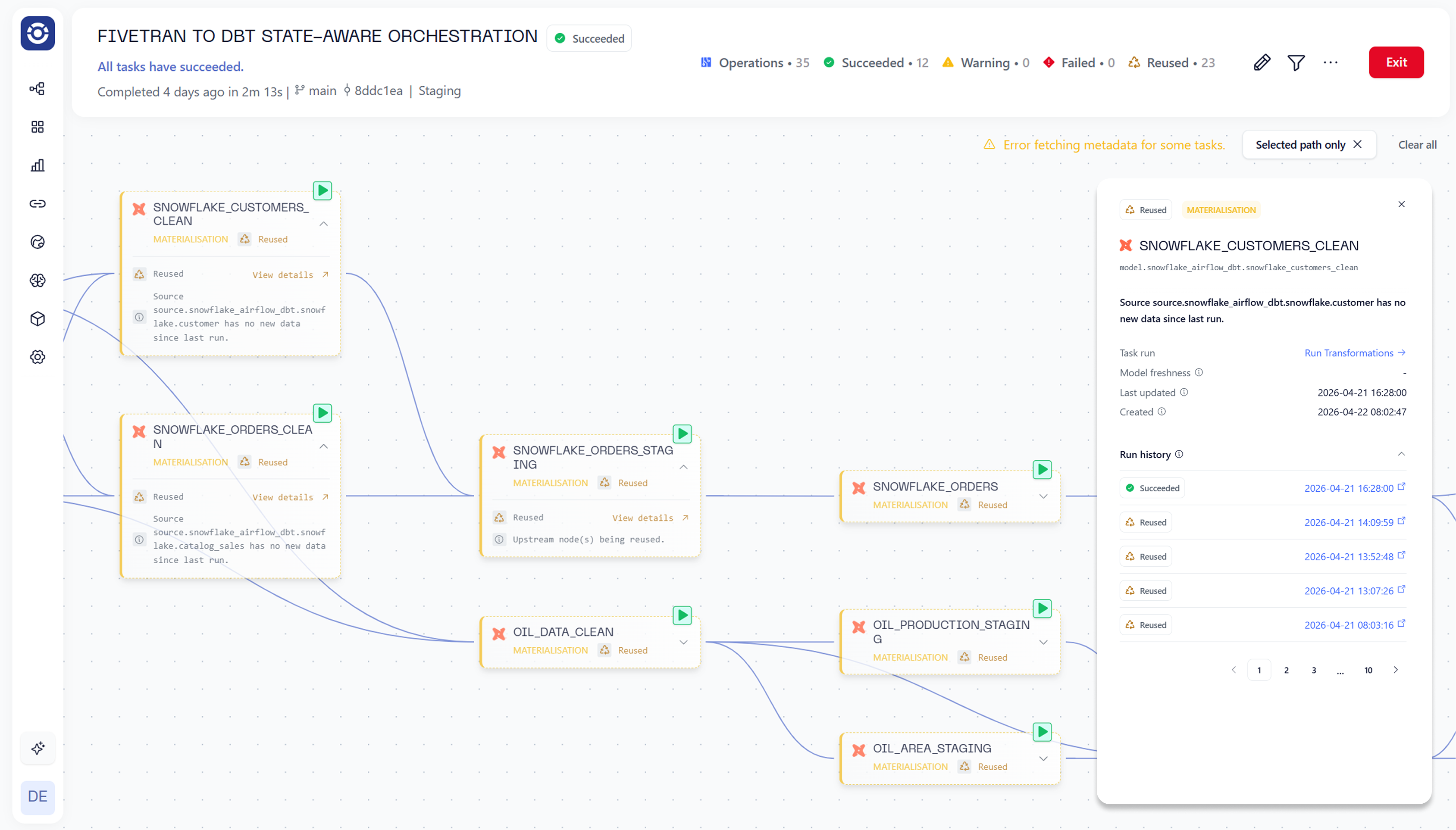
Orchestra orchestrates the data and AI artefacts that flow through your CI/CD pipeline — coordinating retraining, evaluation and deployment with full lineage and freshness guarantees. It complements your build system by governing what gets promoted and ensuring the data behind every model is current and traceable.
Rollback and incident response for AI deployments
Because AI quality is statistical rather than binary, your AI CI/CD pipeline needs a different posture toward failure than a traditional one. A model can pass every pre-deployment check and still degrade in production as real-world inputs diverge from your evaluation set. That makes fast, safe rollback essential: you should be able to revert to the previous model, prompt or index version in moments, ideally automatically when production quality metrics breach a threshold. Canary and shadow deployments help here by exposing a new model to a slice of real traffic, or running it alongside the incumbent without serving its output, so you catch regressions before they affect everyone. Treating models, prompts and retrieval configurations as independently versioned and independently revertible artefacts is what makes this possible — and it is why the line between CI/CD and production monitoring blurs for AI systems.
Team practices for AI-enabled CI/CD
Tooling is only half the story; how a team works around the pipeline determines whether AI helps or introduces new risk. A few practices consistently pay off:
- Keep AI suggestions reviewable. Auto-generated fixes and AI code-review comments should inform human decisions, not bypass them for anything reaching production.
- Version everything that affects behaviour, including prompts, datasets and model configurations, so any deployment is reproducible and revertible.
- Maintain an evaluation set that reflects reality and grow it every time a new failure mode appears in production.
- Run blameless post-mortems on AI incidents and feed the lessons back into gates and monitoring.
- Resist automation complacency. The goal is to raise the floor on quality and speed, not to switch off human judgement.
Teams that pair capable AI tooling with these habits ship faster and more safely; teams that adopt the tooling without the habits tend to trade one class of problem for another.
A phased plan for adopting AI in CI/CD
You do not need to transform your whole delivery process at once. A phased adoption plan lets you capture value early while managing risk. Start by introducing AI where the downside is low and the upside is obvious: AI-assisted code review and test summarisation, which inform humans without changing what ships. Next, add test intelligence to cut feedback time, measuring escaped defects carefully to ensure speed does not cost quality. Then, for AI products specifically, build the evaluation gates and artefact versioning that let you ship models, prompts and indexes safely, connecting CI/CD to your data pipeline. Only once those foundations are solid should you experiment with agentic automation that takes action, and even then behind firm approval gates. Throughout, keep your baseline metrics — lead time, recovery time, change failure rate — in view, so each step proves its value before you take the next. This incremental path consistently beats a big-bang adoption that introduces several new risks at once and leaves you unable to tell which change helped and which hurt.
Conclusion
The AI CI/CD pipeline makes delivery faster and smarter while raising the bar for shipping AI safely. Use AI to optimise testing, triage and review; adopt agentic automation carefully and behind approval gates; and pair your pipeline with a strong MLOps stack and automation tooling to get the full benefit.